BS 8674:2025 — What the New Competency Framework Actually Means for Your Practice
BS 8674 landed in August 2025. It's not legislation — but it's quickly becoming the benchmark that clients, insurers, and enforcement officers measure you against. If you carry out fire risk assessments commercially, this standard is about you. Here's what it actually changes.
What BS 8674 is (and isn't)
BS 8674:2025 is a code of practice published by BSI that sets out a national framework for assessing the competence of individual fire risk assessors. The key word there is individual — it's about you as a practitioner, not your firm.
It doesn't tell you how to carry out a fire risk assessment. That's still the job of PAS 79-1 (for non-housing premises) and BS 9792:2025 (for housing). BS 8674 sits alongside those method documents and answers a different question: is the person doing the assessment actually competent to do it, given the type of building involved?
The scope is limited to general, non-invasive fire risk assessments — visual inspections and review of existing records. It explicitly excludes fire risk appraisals of external wall constructions (that's PAS 9980), invasive or destructive inspections, fire engineering, and specialist environments like nuclear facilities. If your work stays within the bounds of a standard Type 1, 2, or 3 FRA, BS 8674 applies to you.
Three tiers, mapped to building risk
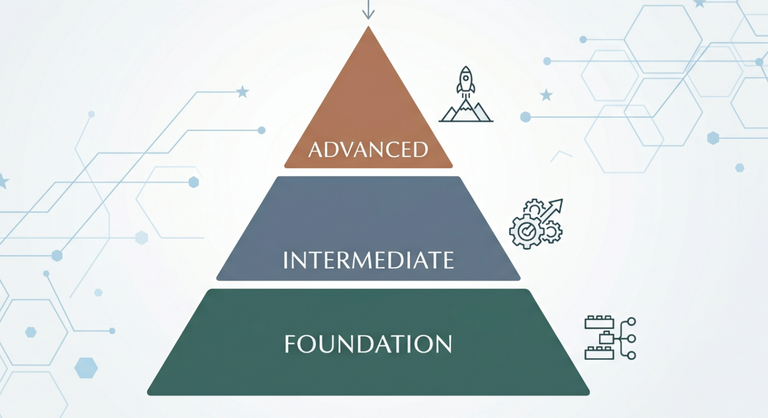
The framework introduces three competency levels: Foundation, Intermediate, and Advanced. Each is tied to a building risk profile, not to years of experience or a particular qualification.
Foundation covers low-risk premises — think small offices, local shops, small warehouses. Buildings with straightforward layouts, low occupancy, and conventional construction. If the fire safety arrangements are simple and the risk is relatively contained, a Foundation-level assessor can work independently.
Intermediate is where most commercial fire risk assessors will sit. This level covers moderate-risk buildings: hotels, boarding houses, common areas of apartment blocks, schools, offices with more complex layouts, and entertainment venues. The fire safety arrangements are more involved, the occupancy patterns more varied, and the assessment demands a broader base of knowledge.
Advanced applies to high-risk, complex environments — large residential blocks, care homes, hospitals, buildings with challenging evacuation requirements or unusual construction. These are the assessments where getting it wrong has the most serious consequences, and where the standard expects the deepest level of expertise.
The principle running through all three tiers is straightforward: match your capability to the building's risk profile. And if a job sits above your level, escalate it. BS 8674 makes this explicit — working beyond your competence isn't just poor practice, it's now a defined breach of the framework's code of conduct.
It's worth noting that the building risk profiles in BS 8674 don't always align with intuition. A two-storey residential care home, for instance, presents a higher risk to occupants than a twenty-storey office building. Risk is about the people and the context, not just the height of the structure.
SKEB: what "competent" actually looks like now
BS 8674 assesses competence across four pillars, referred to as SKEB: Skills, Knowledge, Experience, and Behaviours.
Skills means the practical ability to apply fire safety principles in the field — not just knowing the theory, but using it effectively when you're standing in a building making judgements.
Knowledge covers the technical and legislative foundations: fire dynamics, building construction, fire protection systems, relevant legislation, and the guidance documents that apply to the premises you assess.
Experience is documented evidence of the types of buildings you've assessed and the time you've spent doing it. This is where BS 8674 gets specific — experience needs to be relevant to the competency level you're claiming. Assessing fifty small offices doesn't make you competent to assess a complex care home.
Behaviours is the one that often gets overlooked but arguably matters most. It covers professional and ethical conduct: integrity, managing conflicts of interest, acknowledging the limits of your competence, and a commitment to continuing professional development. The standard includes a code of conduct that formalises expectations many competent assessors already meet instinctively — but that haven't been written down in a British Standard before.
The important point is that qualifications contribute to demonstrating competence, but they're not sufficient on their own. A diploma shows knowledge. SKEB asks for the full picture.
What this means for your practice
Here's where it gets practical.
Assess your own scope honestly. Look at the buildings you currently assess and map them against the three risk profiles. If most of your work falls within Foundation or Intermediate, that's fine — own it, and make sure your evidence supports it. If you're regularly assessing complex buildings, consider whether your documented experience and CPD genuinely support an Advanced claim.
Expect clients to ask better questions. Responsible persons now have a published framework to reference when appointing assessors. The days of "are you qualified?" as the only competency question are numbered. Increasingly, clients — and their insurers — will want to know which BS 8674 level you operate at, and what evidence you hold.
BAFE SP205 is aligning. Version 6 of the BAFE SP205 scheme has already been revised to align with BS 8674, endorsed by UKAS. If you're SP205-registered (or planning to be), this isn't a separate thing to worry about — it's the same direction of travel. The updated scheme requires on-site audits to verify FRA performance, not just management systems.
Your reports are part of your evidence trail. Demonstrating competence under SKEB isn't only about certificates and CPD logs. The quality, structure, and standards-compliance of the assessments you produce are tangible evidence of your professional capability. A well-structured report that follows the methodology in PAS 79-1 or BS 9792 speaks to your skills and knowledge in a way that a certificate alone cannot.
Specialising is commercially smart. BS 8674 rewards assessors who are clear about what they do well. Rather than stretching into building types that sit outside your core experience, the framework incentivises depth. Know your lane, do excellent work within it, and build a reputation that clients trust.
How FireCheckr supports competent practice
BS 8674 raises the bar on what assessors need to demonstrate. FireCheckr is built to help you meet it:
- Our templates are structured around PAS 79-1 and BS 9792, so the reports you produce follow the methodology the standards expect.
- Our smart note taking system will help you write more detailed, qualitative assessments without taking up more of your time.
- Our validation workflow helps demonstrate a transparent and compliant process of internal and peer-to-peer review.
- When BAFE comes knocking, you can show them exactly how you manage your practice with a special BAFE export report.
The result is consistent, well-documented output that reflects your expertise and supports your evidence trail under SKEB.
Related articles

The Golden Thread: Why It Matters for Fire Risk Assessors, Not Just Building Owners
Mandatory FRA Certification Is Coming — What the MHCLG Consultation Means for You